Brandol & Associates
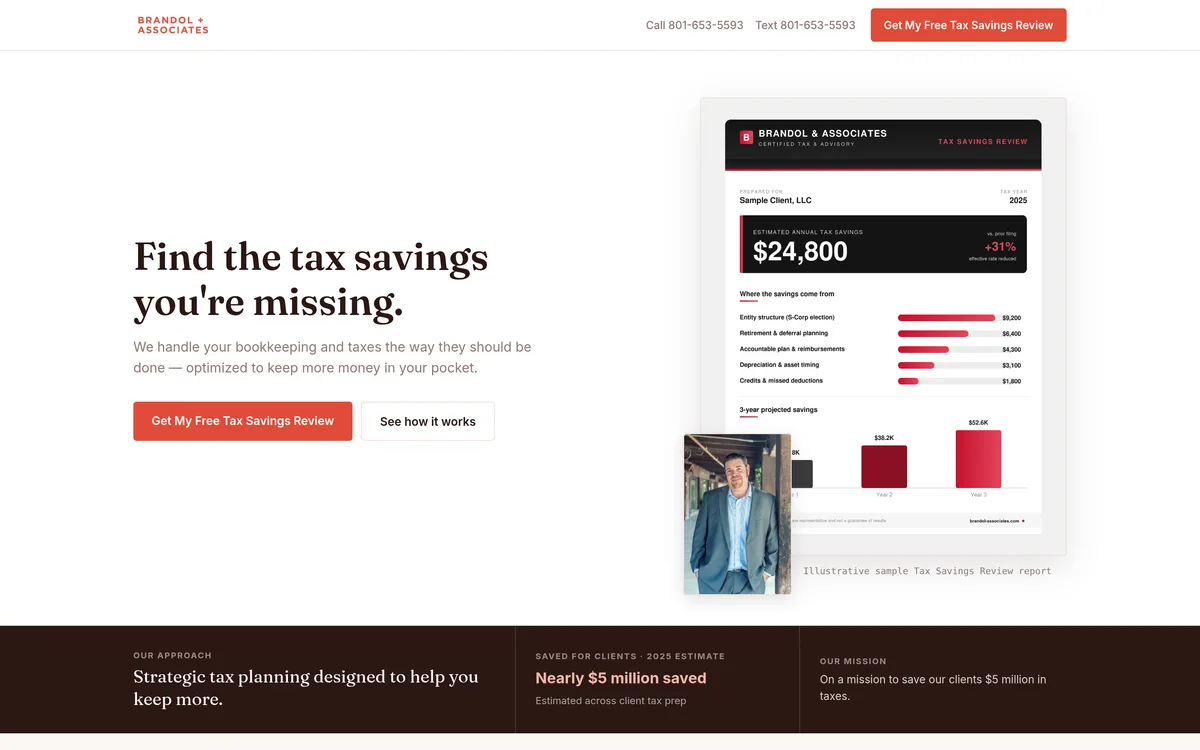
Site for an accounting firm with its own booking calendar and a calculator that estimates tax savings and hands them over as a branded report.
The challenge
A small accounting firm doesn't compete on price: it competes on trust. The site had to do two things in the same visit (explain what the firm does and get the visitor to book) without asking them to pick up the phone or wait for an email reply.
What we built
One page that leads to the calendar. The visitor picks a day and time right there; the appointment lands directly in the firm's CRM. There's no form for someone to read and answer the next day.
A calculator that hands something over. Anyone not ready to book answers four questions and gets an estimate of how much they could save on taxes, with their report as a PDF, carrying the firm's brand and generated on the spot. That report is the reason to leave an email address, and the email is what then enters the CRM.
The business details in a single place. Name, address, phone, hours and services are written once and come out on their own in the menu, the footer, the legal pages, the PDF and the data Google reads. Before that was centralized, the usual thing had already happened: a phone number updated in one place and stale in another.
How it works inside
The site is static: it's served ready-made, with nothing to compute per visit. The only thing that needs a server is the form submission, and a tiny function handles it.
That function exists for one concrete reason. If the browser posts straight to the CRM, the answer comes back opaque: there's no way to tell whether the contact went through or was lost. Routing it through our side makes the result readable, and a failure shows up instead of vanishing silently.
The PDF is assembled in the browser of whoever asks for it. There's no third-party service charging per document, and the code that generates it isn't downloaded until someone presses the button.
And where there was no confirmed fact, nothing was invented: the business coordinates were left out of the listing data until they could be taken from the map. A wrong pin on a local listing is worse than no pin.